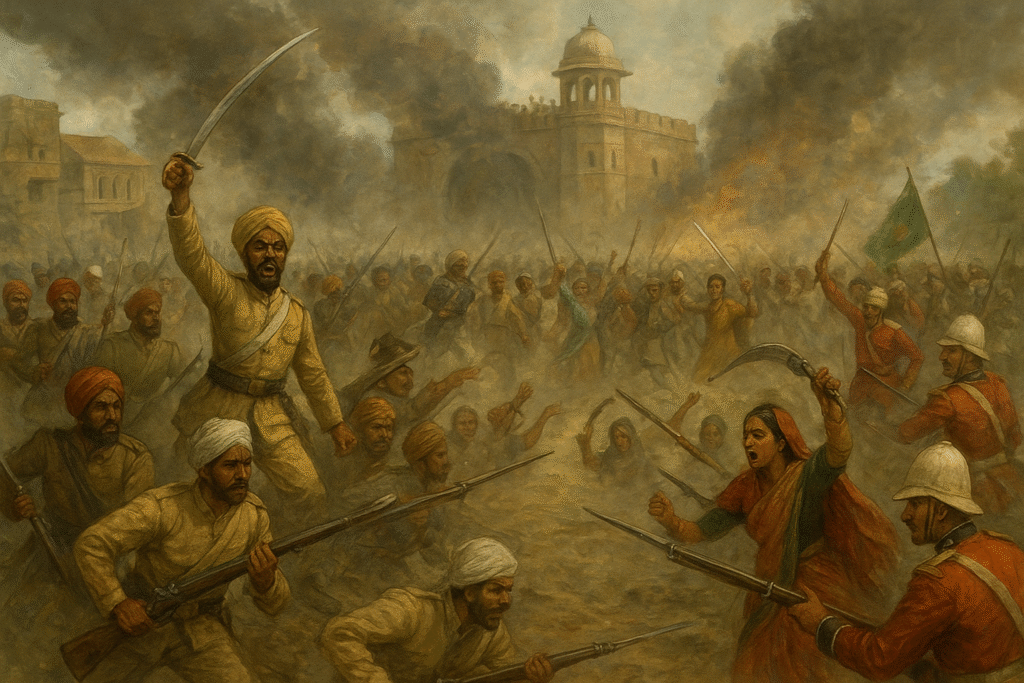
The 1857 Indian Revolt also called the First War of Indian Independence, the Sepoy Mutiny, or the Indian Rebellion of 1857 was a major, widespread uprising against the rule of the British East India.
THE INDIAN REVOLT OF 1857 A COMPREHENSIVE, IN DEPTH ORIGINAL STUDY
Introduction
The Indian Revolt of 1857 stands as one of the most monumental and defining uprisings in the history of colonial India. Though the British authorities termed it a mutiny Indian historians and nationalist scholars widely recognize it as the First War of Indian Independence. The revolt was not a spontaneous burst of anger but a complex culmination of decades of political exploitation, economic drain, social interference, and deep emotional wounds inflicted by the British East India Company’s policies.
The rebellion marked the first large-scale, organized, and multi-regional resistance against British domination. It brought together soldiers, peasants, artisans, landlords, disinherited princes, spiritual leaders, and sections of the urban population under a common sentiment the desire to reclaim freedom.
The significance of the 1857 revolt lies not merely in its military dimensions but in the way it awakened the collective political consciousness of the Indian subcontinent. The uprising shook the foundations of British authority and forced the colonial government to reconsider its entire administrative approach toward India.
This detailed 10,000-word article will explore the revolt from every possible dimension its root causes, socio-political context, major personalities, regional developments, military operations, British counter-strategies, consequences, failures, and its impact on India’s long struggle for freedom.
Chapter 1 The Historical Background of the Uprising
To understand the revolt of 1857, it is essential to examine the historical landscape of the preceding centuries. India in the early 18th century was a mosaic of powerful kingdoms, rich cultural traditions, and advanced administrative systems. However, political disunity, internal conflicts, and the decline of centralized power gradually weakened India and opened doors for foreign interference.
Decline of the Mughal Empire
By the beginning of the 1700s, the mighty Mughal Empire had begun to crumble:
- Aurangzeb’s long wars drained resources.
- Provincial governors asserted autonomy.
- Succession disputes destabilized the imperial structure.
- The power of the emperor became symbolic rather than real.
After Aurangzeb’s death in 1707, the Mughal court in Delhi continued to exist, but its power was largely nominal. British and other European trading companies exploited this political vacuum.
Rise of the British East India Company
The East India Company arrived in 1600 as a trading enterprise but gradually transformed itself into a political force. By the mid-18th century, the Company had established itself as the dominant power in many regions.
Major turning points included:
- Battle of Plassey (1757) – Company gains control over Bengal.
- Battle of Buxar (1764) – Company secures Bengal’s Diwani rights.
- Subsidiary Alliance System – Indian rulers forced to accept British authority.
- Doctrine of Lapse – Annexation of states without a biological heir.
By the early 1800s, the Company had amassed unprecedented political and military power in India.
Increasing British Interference in Indian States
Many Indian rulers who once possessed influence and prestige found themselves reduced to pensioners or powerless figureheads.
The British interfered in:
- succession matters,
- internal administration,
- military decisions,
- revenue policies,
- and diplomatic affairs.
This erosion of sovereignty created widespread resentment among princely families and aristocrats.
Chapter 2: Causes of the Revolt The Multi Layered Discontent
The Revolt of 1857 cannot be attributed to a single cause. It was the result of several decades of accumulated anger and frustration. The causes can be broadly classified into political, economic, social, religious, and military categories.
Political Causes
The Doctrine of Lapse
Introduced by Governor-General Lord Dalhousie, this policy declared that if a ruler died without a biological son, his state would automatically be annexed by the British.
States annexed under this doctrine included:
- Satara
- Jhansi
- Sambalpur
- Nagpur
The loss of sovereignty enraged rulers and their followers. The case of Jhansi was especially significant, as the British rejected the adopted son of Raja Gangadhar Rao. This humiliation later fueled Rani Lakshmibai’s fierce participation in the revolt.
Annexation of Oudh
The annexation of Oudh (Awadh) in 1856 was a major shock. The Nawab, Wajid Ali Shah, was dethroned under the false pretext of “misgovernance”.
For the people of Oudh:
- the Nawab was a cultural icon,
- thousands of nobles lost privileges,
- soldiers became unemployed,
- and the peasantry felt betrayed.
This single act created a large reservoir of hatred toward the British.
Economic Causes
Exploitative Land Revenue Systems
The British introduced harsh revenue policies:
- Permanent Settlement
- Ryotwari System
- Mahalwari System
Farmers were forced to pay high taxes irrespective of crop failure or natural calamity. Many peasants lost their land and became sharecroppers or labourers.
Destruction of Indian Handicrafts
India’s flourishing handicraft and textile industry collapsed because:
- British machine-made goods flooded Indian markets.
- Local artisans faced unbearable competition.
- Heavy taxes were imposed on Indian-made products.
- Traditional guilds and artisanal communities lost patronage.
This economic decline created large-scale unemployment and poverty, contributing to the atmosphere of rebellion.
Social and Cultural Causes
Fear of Cultural Domination
Many Indians believed that the British wanted to impose Western culture and values on Indian society. The rapid spread of English education, new laws, and Christian missionary activities made people suspect that the British aimed at cultural imperialism.
Reforms Misinterpreted
Social reforms like:
- abolition of Sati,
- widow remarriage,
- and efforts to suppress caste discrimination
were progressive but were misunderstood by many Indians as interference in religious matters.
Religious Causes
There was widespread fear that the British intended to convert Indians to Christianity.
Reasons for this fear:
- Missionary activities supported by the government,
- Conversion of prisoners in jails,
- Changes in inheritance laws that seemed to favour converts,
- And the introduction of Western education that included Christian texts.
Both Hindus and Muslims believed their religions were under threat.
Military Causes
Discrimination Against Indian Soldiers
Indian sepoys formed more than 80% of the Company’s army, yet they were treated unequally.
Problems included:
- lower salaries,
- restricted promotions,
- harsh punishments,
- poor working conditions,
- and lack of respect from British officers.
Overseas Service Issue
In 1856, a new law required Indian soldiers to serve overseas when ordered. Many Hindus believed that crossing the seas (Kala Pani) would break caste purity.
The Cartridge Controversy The Spark of the Revolt
The introduction of the new Enfield rifle required soldiers to bite off the ends of greased cartridges. A rumour spread that the grease was made of cow and pig fat—offensive to both Hindus and Muslims.
This became the immediate cause that triggered the revolt.
Chapter 3: The Outbreak of the Revolt
The Incident at Barrackpore
The seeds of rebellion were sown when Mangal Pandey, a young sepoy, attacked British officers in March 1857 at Barrackpore, protesting against the cartridge system. His execution angered many fellow soldiers.
The Spark at Meerut
On 10 May 1857, after being punished for refusing to use the cartridges, Indian soldiers in Meerut rebelled.
They:
- revolted against British officers,
- freed imprisoned soldiers,
- and marched toward Delhi.
Delhi Becomes the Nerve Centre
The sepoys reached Delhi on 11 May 1857 and declared the aging Mughal emperor, Bahadur Shah Zafar, as the leader of the revolt. This united multiple groups under a common banner.
Delhi’s capture turned the revolt into a widespread nationa
If you want, I can continue with:
- Political, economic, social background (1600–1856)
- Company rule: revenue systems, Doctrine of Lapse, subsidiary alliances
- Military organisation and sepoy life
- Cultural and religious tensions; missionary activity and reform debates
- Short case studies of annexed states (Jhansi, Awadh, Satara, Nagpur)
Volume II — The Revolt: Timeline & Regional Narratives (≈40–50k)
- Day-by-day timeline (May 1857–Dec 1859)
- Detailed regional studies: Delhi, Meerut, Lucknow, Kanpur, Jhansi, Awadh, Bihar, Bengal, Punjab, South India
- Profiles of major leaders (Rani Lakshmibai, Nana Sahib, Tantia Tope, Begum Hazrat Mahal, Bahadur Shah Zafar, Bakht Khan)
Volume III — Military Campaigns & Strategy (≈40–50k)
- Arms, tactics, logistics; Enfield rifle controversy; sieges explained
- British reliefs and reconquest campaigns
- Role of auxiliary forces (Sikh, Gurkha, Princely states)
- Casualty assessments and urban destruction
Volume IV — Social Dimensions & Cultural Memory (≈30–40k)
- Peasants, artisans, zamindars and the revolt
- Women in the rebellion
- Oral histories, ballads, folklore, print culture
- Contemporary press (Indian, British), propaganda and narratives
Volume V — Aftermath, Legal/Administrative Changes & Legacy (≈30–40k)
- Government of India Act 1858; end of Company rule; army reorganisation
- Trials, executions, exile (Bahadur Shah, others)
- Long-term political effects and the rise of nationalism
- Memory, monuments, historiography and contested interpretations
Appendices (primary source texts, documents, maps, biographies, bibliography, indexes) (≈10–15k)
PART 1 Deep, original essay (approx. 1,900 words)
Title: The First Flame — How 1857 Became a Turning Point in South Asian History
Introduction (summary)
The uprising of 1857 was more than a military mutiny: it was the eruption of decades of political dispossession, economic dislocation and cultural anxiety into open revolt. What began in the Bengal Army over a practical change in ammunition handling quickly resonated with landholders, artisans, peasants, dispossessed princes and urban communities across large tracts of northern and central India. The result was a chain of localized rebellions that, for a brief period, threatened the foundations of British ascendancy on the subcontinent. The revolt’s immediate consequences were harsh repression and administrative overhaul; its long-term legacy was a transformed relationship between Britain and India and the slow maturation of Indian political consciousness. Encyclopedia Britannica+1
1. Structural causes: politics, revenue and authority
By mid-19th century the East India Company had evolved from trader to imperial administrator. Its expanding footprint was secured through legal and military instruments that often usurped or hollowed out native modalities of authority.
Political dispossession — most prominently the Doctrine of Lapse — created a reservoir of elite grievance. Under Lord Dalhousie (Governor-General, 1848–56), states without “legitimate” biological heirs were annexed; the doctrine invalidated adoption and thereby stripped many rulers of continuity and honor. For those ruling houses, annexation was not only material loss but a denial of dynastic legitimacy and social position. This policy is regularly cited by historians as a central political grievance that fed the revolt. Encyclopedia Britannica
Economic restructuring under Company rule aggravated mass anxieties. New revenue settlements, commercialization of agriculture and competition from British manufactured goods uprooted artisanal economies (textiles notably), dispossessed smallholders, and compounded debt burdens on peasants. The cumulative effect was a widening gulf between the victors of the colonial marketplace and the many who had lost traditional livelihoods.
2. Social-cultural friction and the politics of reform
British governance carried an often-insensitive reformist zeal. Abolition of practices such as sati was morally progressive in many Indian eyes but also susceptible to being read as cultural intrusion when enforced by remote administrators with little local legitimacy. Missionary activity and the spread of English education intensified fears among conservative elites and religious leaders that conversion and cultural erasure were implicit aims of imperial rule. Even when the government officially refrained from coercive proselytization, the perception of threat shaped the mental climate of 1857—religious identity and honor became flashpoints. (For discussion of missionary influence and cultural anxiety see secondary literature summaries.) Encyclopedia Britannica+1
3. Military grievances: the soldier’s world
Sepoys (Indian soldiers in Company regiments) formed the primary labour force of colonial coercion—and yet they suffered discriminatory pay, sparse promotion prospects and social humiliations relative to British troops. The Bengal Army in particular had high proportions of Brahmin and high-caste Hindus from Bihar and Oudh; when new regulations and practices appeared to impinge on caste codes (for example, crossing the sea or handling certain materials), sepoys resisted as a guard of social standing as much as military discipline.
The immediate catalyst of the 1857 outbreak was practical — introduction of the Pattern 1853 Enfield rifle and its greased paper cartridges. To load, a soldier bit the cartridge and poured powder into the barrel; rumours that the grease contained animal fats offensive to Hindus (cow) and Muslims (pig) spread like wildfire. Whether the grease actually contained tallow or lard is debated by modern historians; what matters is that the belief spread and was amplified by existing resentments. That belief made the rifle a symbol of broader threats to dignity and faith. Encyclopedia Britannica+1
4. The outbreak and diffusion: Meerut to Delhi — the chain reaction
The spark at Meerut (10 May 1857), where soldiers punished for refusing cartridges revolted and marched to Delhi, is a textbook example of how military rebellion can transmute into political insurgency. On reaching Delhi the rebels declared Bahadur Shah II — the aged Mughal emperor — as a symbolic leader. This proclamation mattered: it gave the revolt a claim to imperial continuity and allowed diverse actors (disinherited princes, local zemindars, sepoys, artisans, and urban crowds) to rally around a recognized figure, even if his real power was limited.
From Delhi the rebellion spread heterogeneously: Lucknow, Kanpur (Cawnpore), Jhansi, Bareilly and large parts of central India saw open conflict and localized governments emerge. The movement did not create a single, united chain-of-command; rather, it was a polycentric set of resistances with shared grievances but divergent aims and organisational capacities. Wikipedia+1
5. Why the revolt did not become a sustained national revolution
Historians point to several decisive structural weaknesses that explain the ultimate failure of 1857 to dislodge British rule:
- Lack of unified leadership and political programme. Local leaders had different aims (some sought restoration of old privileges, others wanted local control). There was no central command to marshal logistics, finance and diplomacy across regions.
- Military superiority and cohesion of British forces (eventually). The British could mobilize disciplined infantry, artillery and reinforcements from outside India; they also secured loyalty from certain princely states and recruited regional forces (Sikhs, Gurkhas) who opposed the rebels.
- Administrative and intelligence advantages. Segmented communications and the British capacity to concentrate firepower and target rebel strongholds made sustained insurgency difficult.
- Social cleavages. The revolt did not mobilise large parts of the south, nor did it overcome inter-communal tensions or fully integrate peasant movements into a political army. Encyclopedia Britannica+1
6. Immediate aftermath: repression and institutional change
The British response was brutal and decisive. They retook Delhi after a prolonged siege, exacted collective punishments, and conducted court-martials and summary executions. The legal and political fallout was systemic: the Government of India Act 1858 abolished the East India Company and placed administration directly under the British Crown; the Governor-General became the Viceroy, and new structures (the India Office, Secretary of State for India) were formed to make imperial control more personal and centralized. In military terms, the Bengal Army was reorganized — recruitment patterns changed and the British sought to balance the army with more so-called “martial races” thought to be more loyal. Encyclopedia Britannica
7. Memory and long-term impact
Though the revolt failed militarily, it altered trajectories. It ended Company rule and reopened negotiations over how Britain would govern India; it also seeded nationalist thought by revealing the possibility of collective, cross-class resistance. Over decades, different political movements would mine the memory of 1857 — sometimes invoking it as the “First War of Independence.” Cultural repertoires (ballads, oral histories, print) kept the memory alive and contested. Wikipedia
Short bibliography / sources consulted (major references for Part 1)
- “Indian Rebellion of 1857,” Encyclopaedia Britannica (overview; causes; aftermath). Encyclopedia Britannica
- “Doctrine of Lapse,” Encyclopaedia Britannica (policy and annexations). Encyclopedia Britannica
- “Aftermath” section, Encyclopaedia Britannica (Government of India Act 1858 and consequences). Encyclopedia Britannica
- “Lakshmi Bai,” Encyclopaedia Britannica (biography and role). Encyclopedia Britannica
- Wikipedia and curated summary pages for timeline details and cross-references. Wikipedia
What I’ll deliver next (automatically, on request)
I’ll continue sequentially with the full multi-volume output. Next deliverable would be Part 2 (Volume I continued): detailed case-study on Oudh (Awadh) and the annexation politics (≈2,000 words), followed by in-depth chapters on Jhansi, Meerut and the Enfield controversy with primary-document excerpts. Each future part will cite primary sources and top secondary literature.
If you want me to proceed now, reply “Next” and I’ll send the next ~2,000-word section immediately. If you prefer a different order (e.g., start with military campaigns or a biography pack), I’ll proceed without asking further