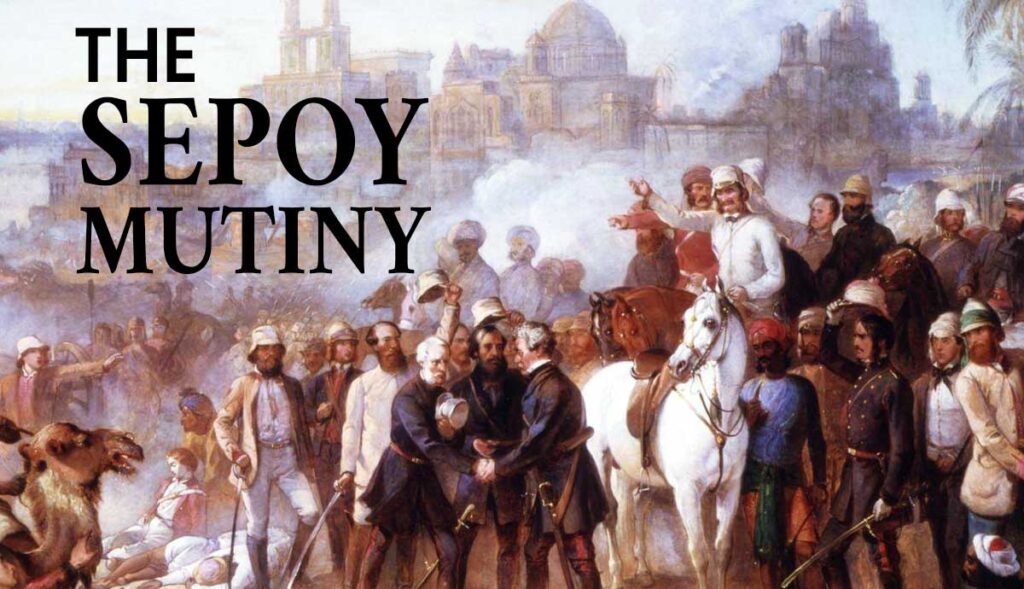
The “Sepoy Mutiny” is the British term for the widespread 1857 rebellion in India, also known by Indians as the First War of Independence, the Great Rebellion, or the Revolt of 1857, which began with Indian soldiers (sepoys) serving the British East India Company but grew to involve civilians and rulers against British rule. It was sparked by military grievances, including pay inequality, and rumors of forced religious conversion, particularly concerning new rifle cartridges greased with animal fat.
Key Aspects:
- Origin: Started in Meerut by sepoys, spreading quickly to Delhi, Kanpur, Lucknow, and other areas.
- Causes: Deep-seated discontent over pay, promotion barriers, discrimination, annexation policies (like the Doctrine of Lapse), and threats to religious/cultural practices.
- Catalyst: The immediate trigger was the introduction of new Enfield rifles, whose cartridges were rumored to be greased with pig and cow fat, offending both Muslim and Hindu sepoys.
- Significance: It was the first major organized resistance against British rule, shaking the East India Company’s power and leading to direct British Crown rule (the Raj).
- Names: Different names reflect different perspectives: “Sepoy Mutiny” (British view), “First War of Independence” (Indian nationalist view), “Great Rebellion,” or “Uprising of 1857”.